Choosing salon software VAT features carefully matters more than ever for salons in the UAE and Saudi Arabia. Every bill needs to be a correct tax invoice, VAT has to be calculated properly on services, products, packages and gift cards, and both countries are moving to mandatory e-invoicing. This guide explains what UAE and Saudi salons need from VAT billing software, what’s changing with e-invoicing, and what to check before you choose a system.
This guide is general information, not tax advice. Rules change, so always confirm your own obligations with your accountant or tax adviser.
In this guide
- Why VAT Is Tricky for Salons
- UAE: Salon VAT Invoice Basics
- UAE: E-Invoicing Is Coming
- Saudi Arabia: VAT and ZATCA E-Invoicing
- UAE vs Saudi Arabia at a Glance
- Must-Have Features in VAT Billing Software for Salons
- Common Salon VAT Mistakes
- Questions to Ask Your Software Vendor
- Frequently Asked Questions
- Final Thoughts
Why VAT Is Tricky for Salons
Value-added tax sounds simple: add the rate to the bill. In a salon, it gets complicated quickly:
- Mixed bills with services and retail products on the same invoice.
- Packages and memberships paid up front and used over several visits.
- Gift cards and vouchers sold now and redeemed later.
- Discounts and promotions that change the taxable amount.
- Refunds and credit notes that have to match the original invoice.
- Corporate clients who need full tax invoices with their own tax number.
- Several branches that all need consistent invoicing.
Doing this by hand or with a basic till leads to mistakes. Salon software with built-in VAT handling gets it right on every bill.
UAE: Salon VAT Invoice Basics
In the UAE, the standard VAT rate is 5% on most standard-rated supplies, and a tax invoice must be issued within 14 days of the supply. The UAE uses two main invoice types:
| Invoice type | When salons usually use it |
|---|---|
| Simplified tax invoice | Most everyday client bills, because the client isn’t VAT-registered |
| Full tax invoice | VAT-registered business clients, such as corporate wellness or hotel contracts, where the supply is over AED 10,000 |
A simplified tax invoice can be used when the customer isn’t VAT-registered, or when a registered customer’s invoice doesn’t exceed AED 10,000. Above that amount, a VAT-registered customer needs a full tax invoice with their name, address and TRN.
Your salon software should choose the right format automatically and always show your own name, address and TRN, the invoice number and date, and the VAT charged.
UAE: E-Invoicing Is Coming
The UAE is introducing a national e-invoicing system. The Ministry of Finance issued Ministerial Decisions No. 243 and 244 of 2025 to set the framework and the phased timeline, and it published official e-invoicing guidelines in February 2026.
| Phase | Who | Appoint a provider by | Go-live |
|---|---|---|---|
| Phase 1 | Annual revenue of AED 50 million or more | 30 October 2026 | 1 January 2027 |
| Phase 2 | Annual revenue below AED 50 million | 31 March 2027 | 1 July 2027 |
| Phase 3 | Government entities | 31 March 2027 | 1 October 2027 |
Most salons will fall into Phase 2. Businesses will need to appoint an Accredited Service Provider (ASP) to send and receive electronic invoices. The requirement applies to businesses operating in the UAE whether or not they’re VAT-registered, unless specifically excluded.
Which of your transactions are in scope, especially everyday sales to individual clients, depends on the detailed rules. Check with your accountant, and ask your software vendor how they plan to support the UAE system and which ASP they work with.
Saudi Arabia: VAT and ZATCA E-Invoicing
Saudi Arabia’s standard VAT rate is 15%, and e-invoicing has been running for several years under ZATCA, the Zakat, Tax and Customs Authority.
- Phase 1 (Generation): VAT-registered businesses must issue invoices electronically from a compliant system, with the required fields and a QR code on simplified invoices. Handwritten or spreadsheet invoices aren’t acceptable.
- Phase 2 (Integration): businesses must connect their invoicing system to ZATCA’s Fatoora platform. This is being rolled out in waves based on turnover.
Phase 2, effective from 1 January 2023, requires integrating your system with ZATCA and sending e-invoices and e-notes to ZATCA, and it’s being rolled out in waves. Under Wave 25, taxpayers with taxable turnover above SAR 187,500 in 2022, 2023, 2024 or 2025 should be ready for Phase 2 by 1 February 2027. ZATCA notifies each wave at least six months before its integration date.
With such a low threshold, many Saudi salons are now in scope or will be soon. Your salon software must be ZATCA-compliant, not just able to print a receipt with VAT on it.
See our salon software in Saudi Arabia page for more.
UAE vs Saudi Arabia at a Glance
| Area | UAE | Saudi Arabia |
|---|---|---|
| Standard VAT rate | 5% | 15% |
| Tax authority | Federal Tax Authority (FTA) | ZATCA |
| Tax number on invoices | TRN | VAT registration number |
| E-invoicing status | Phased rollout from 2027 | Already live, Phase 2 waves ongoing |
| Key system requirement | Connect through an accredited service provider | Integrate with the Fatoora platform |
Must-Have Features in VAT Billing Software for Salons
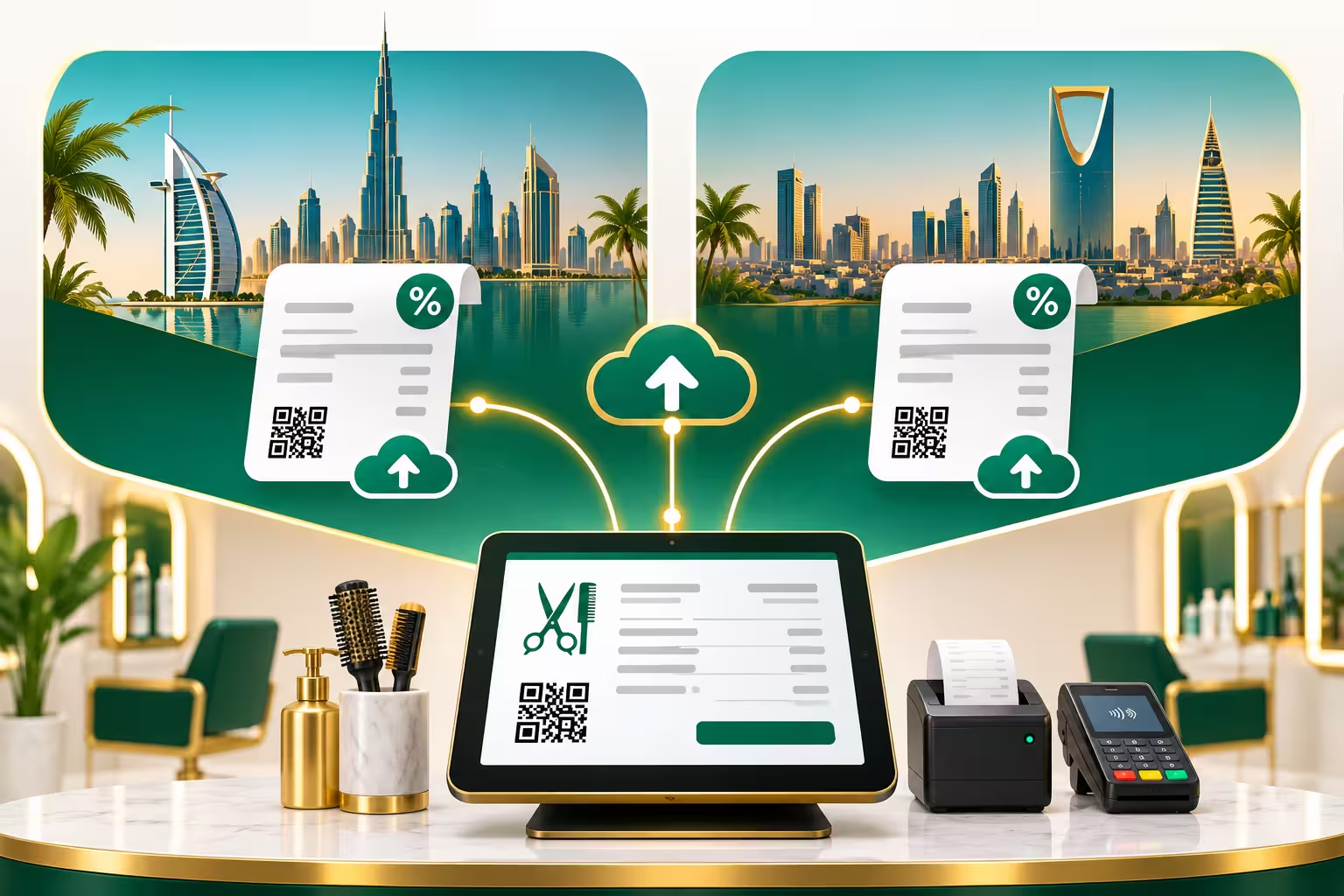
Whether you’re in Dubai or Riyadh, VAT billing software for a salon should include:
- Automatic VAT calculation on services, products and packages at the right rate.
- Correct invoice formats, simplified and full, chosen automatically.
- Your tax number, sequential invoice numbers and dates on every invoice.
- QR codes where required, as in Saudi Arabia.
- Corporate client details, including their tax number for full invoices.
- Credit notes linked to the original invoice for refunds.
- Correct handling of packages, memberships and gift cards, following your accountant’s advice on when VAT is due.
- Bilingual invoices in Arabic and English.
- VAT reports by period and branch, ready for your accountant.
- E-invoicing readiness: ZATCA integration in Saudi Arabia and a clear plan for the UAE system.
- Secure invoice storage so records can be retrieved if the tax authority asks.
Read more: Salon POS System: Billing, Retail and Payments and Salon POS System in Dubai
Common Salon VAT Mistakes
- Handwritten or spreadsheet invoices that don’t meet the required format.
- Missing tax numbers on invoices.
- Gaps or duplicates in invoice numbering.
- Applying VAT to the wrong amount after discounts.
- Refunds without credit notes.
- Treating gift cards and packages inconsistently.
- Different invoicing at each branch.
- Waiting until the deadline to prepare for e-invoicing.
Questions to Ask Your Software Vendor
- Can you show me a sample simplified and full tax invoice from your system?
- Is your system ZATCA-compliant for Phase 1 and Phase 2?
- How will you support the UAE e-invoicing system, and which Accredited Service Provider do you work with?
- How do you handle VAT on packages, memberships and gift cards?
- Can invoices be issued in Arabic and English?
- What VAT reports can I export for my accountant?
- How long are invoices stored, and can I export them?
Frequently Asked Questions
Does my salon need special software for VAT?
If you’re VAT-registered, you need to issue correct tax invoices for every sale. In Saudi Arabia, invoices must come from a compliant electronic system. Salon software with built-in VAT handling makes this automatic.
What should a salon VAT invoice include in the UAE?
At minimum, your name, address and TRN, the invoice number and date, a description of the services or products, the VAT charged and the total. Full tax invoices for VAT-registered clients also need the client’s details and TRN.
When does UAE e-invoicing start for salons?
Businesses with annual revenue below AED 50 million are in Phase 2, with a deadline to appoint a provider of 31 March 2027 and a go-live date of 1 July 2027. Confirm your own scope with your accountant.
Do Saudi salons need ZATCA-integrated software?
Many do. Phase 2 waves now cover businesses with relatively low turnover, so check whether ZATCA has notified you and make sure your software supports Fatoora integration.
How should VAT be applied to gift cards and packages?
The right treatment depends on the type of voucher or package and the local rules. Ask your accountant, then make sure your software can apply that treatment consistently.
Can one system handle both UAE and Saudi branches?
Some can. Check that the software supports different VAT rates, invoice formats and e-invoicing requirements for each country.
Final Thoughts
VAT and e-invoicing rules in the UAE and Saudi Arabia are getting stricter, and salons can’t afford to rely on handwritten bills or basic tills. Look for salon software VAT features that create correct invoices automatically, handle packages and gift cards consistently, support Arabic and English, and have a clear plan for e-invoicing in both countries. Start preparing now, with your accountant and your software vendor, so you’re ready well before your deadline.
VAT-Ready Billing With Sparkalz
Sparkalz by Merak Tech gives salons in the UAE and Saudi Arabia a POS and billing system with booking, packages, gift cards and reports in one place. Ask us how Sparkalz handles VAT invoicing and e-invoicing for your country.